
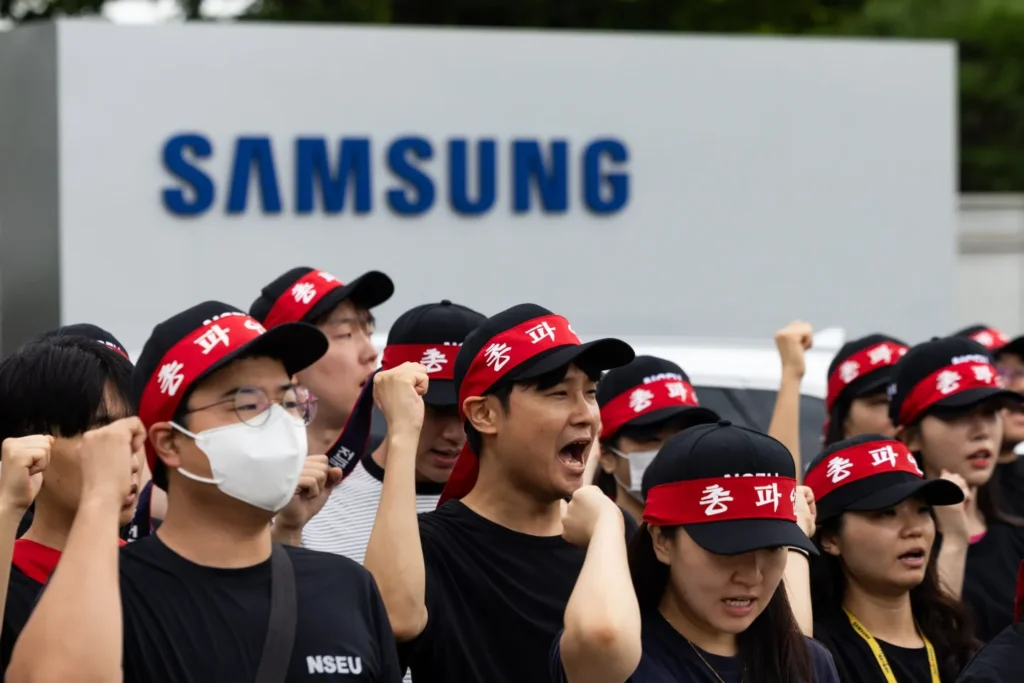
More than 45,000 workers at Samsung Electronics prepare for an 18-day strike starting May 21 after wage and bonus talks failed to reach a final agreement. The planned walkout could affect production of DRAM and High-Bandwidth Memory (HBM) chips used in AI servers, cloud infrastructure, smartphones, and advanced AI systems worldwide.
Samsung is one of the world’s biggest memory chip manufacturers and remains a key supplier for companies building AI infrastructure. Demand for HBM chips has surged rapidly over the past year as companies including Nvidia, Microsoft, Amazon, and Google continue expanding AI data centers and large language model operations in 2026. Analysts say the industry already has very little extra supply capacity, which means even a temporary disruption could quickly impact the broader semiconductor market.
Samsung Labor Tensions
The conflict inside Samsung is mainly focused on bonuses and profit-sharing.
Samsung’s memory chip division has benefited heavily from the global AI race, with reports showing some employees are expected to receive bonuses exceeding 600% of annual salary because of strong semiconductor profits.
But workers in Samsung’s foundry and logic chip divisions say compensation remains far lower despite their role in manufacturing AI-related chips for global technology companies. The union is demanding removal of Samsung’s 50% bonus cap along with allocation of 15% of annual operating profit toward employee bonuses.
The disagreement has now turned into one of the company’s biggest labor disputes in recent years as employees argue the gains from the AI boom are not being shared evenly across Samsung’s semiconductor business.
Global Chip Disruption
The strike could affect Samsung’s semiconductor facilities in Pyeongtaek and Hwaseong, where DRAM, NAND, and HBM chips are produced for global technology companies. These chips are used inside Nvidia AI accelerators, enterprise servers, cloud computing systems, and large-scale AI infrastructure.
Industry analysts warn the disruption may:
- delay AI server deliveries
- increase memory chip prices
- slow data center expansion
- tighten AI hardware availability globally
Earlier worker protests had already reduced some overnight production activity inside Samsung facilities, adding to concerns about how quickly the market could feel the impact if the full strike begins next week.
The timing is especially sensitive because AI hardware demand remains extremely high in 2026, while semiconductor manufacturers are already operating near capacity.
Semiconductor Crisis Concerns
The situation has now become a national economic concern in South Korea.
Government officials have reportedly held emergency discussions to avoid prolonged semiconductor disruption because Samsung remains one of the country’s most important exporters. Officials also warned that even a single day of major semiconductor disruption could create losses worth nearly 1 trillion won, or around $667 million.
A South Korean court has partially approved Samsung’s request to restrict strike activity around critical production and safety operations. Despite that decision, union leaders continue insisting the strike will move forward unless Samsung presents a significantly improved proposal before May 21.
The dispute is now being closely watched across the technology industry because the outcome could influence semiconductor pricing, AI infrastructure expansion, and supply chain planning during one of the fastest periods of AI growth in recent years.