
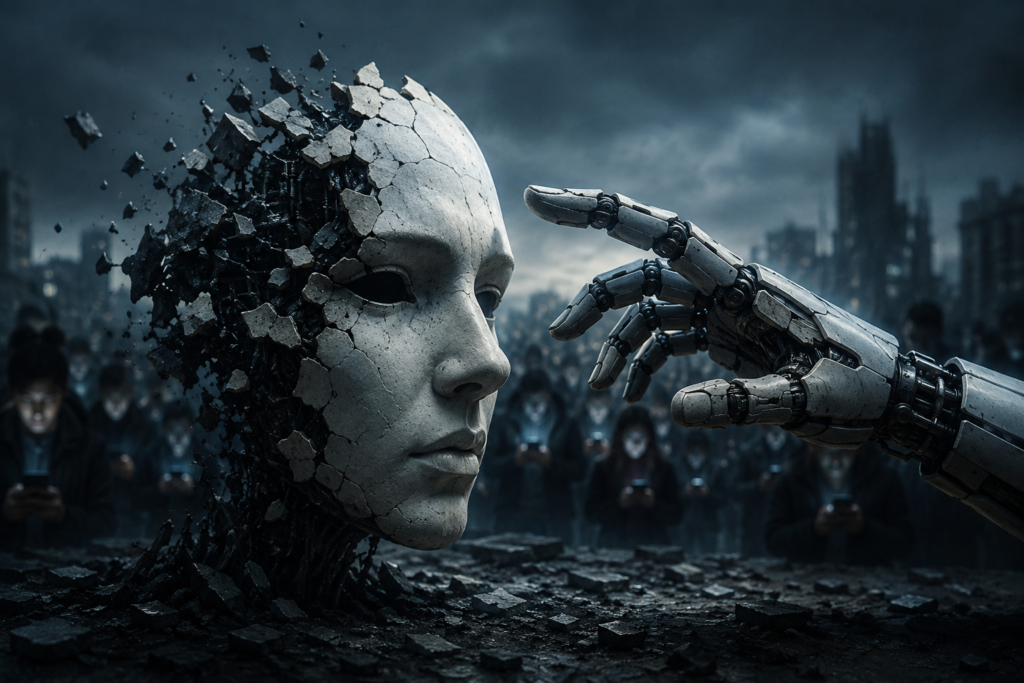
The modern internet was never designed for a world where deception could be automated at industrial scale. Deepfake technology, AI voice cloning, and synthetic media systems are evolving rapidly enough that even trained professionals now struggle to separate real content from manipulated content. AI governance institutions, the World Economic Forum, MIT Media Lab, and multiple digital policy researchers now describe generative AI as a system capable of creating “synthetic realities” where content, identity, and interaction can all be artificially constructed together at massive scale.
Cybersecurity researchers and digital fraud analysts from organizations including Europol and Deloitte increasingly warn that deepfake fraud is becoming cheaper, faster, and globally scalable. One of the clearest warning signs came from the Hong Kong finance fraud case where an employee transferred nearly $25 million during a video meeting involving AI driven impersonations of company executives. Cases like these are beginning to change something deeper than online security itself. They are changing how people emotionally process digital interaction.
The internet is now entering a dangerous psychological phase where people are no longer fully confident in what they see, hear, or read online. Artificial Intelligence has made digital manipulation so realistic that human instincts themselves are starting to fail. The most dangerous part of this crisis is not the technology itself. It is the growing realization that digital evidence may no longer function as reliable proof.
What Is Digital Trust
Digital trust is the confidence people place in online systems, digital communication, platforms, and internet based interactions. It is the reason people trust online banking apps with financial information, rely on video calls for work meetings, believe screenshots shared online, and feel comfortable making decisions through screens without physical verification.
Artificial Intelligence is now disrupting those assumptions. Synthetic voices, digitally manipulated videos, and automated conversations are becoming realistic enough that ordinary users increasingly struggle to distinguish authentic interactions from manipulated ones. The Coalition for Content Provenance and Authenticity (C2PA) and multiple AI governance organizations now indicate that synthetic media is evolving beyond fake images and videos because entire environments of interaction and identity can now be artificially manufactured together. The 2026 Edelman Trust Barometer also showed growing public skepticism around digital authenticity and declining confidence in online institutions as machine generated communication becomes more widespread.
The dangerous part of this crisis is that it spreads psychologically before it spreads technically. Once people begin doubting digital evidence itself, the internet slowly changes from an environment built on convenience into one built on suspicion and verification. In many ways, the internet is no longer struggling only with misinformation. It is beginning to struggle with authenticity itself.
The Collapse of Human Verification
Human instinct evolved in a world where seeing and hearing usually functioned as reliable forms of verification. Artificial Intelligence is now recreating those same signals with alarming realism. Recent AI cognition studies from MIT, the University of Sydney, and multiple behavioral research institutions suggest that human deepfake detection accuracy is now operating only slightly above random guessing in many situations, making digital manipulation harder for ordinary users to identify confidently.
A recent Australian study found that most participants struggled to reliably distinguish real faces from artificially generated faces despite feeling highly confident in their judgments. Researchers involved in the study noted that modern synthetic faces often appear unusually polished and emotionally convincing, making manipulation harder to detect intuitively. The problem is no longer limited to technical fraud detection. Human confidence itself is slowly becoming less reliable inside digital environments.
As synthetic media becomes more deeply integrated into everyday internet experiences, people are starting to spend more time questioning authenticity itself. The more manipulated content users consume online, the more difficult it becomes to confidently separate reality from artificial generation. The internet is slowly evolving from a system built around instinctive trust into one that increasingly depends on skepticism and digital confirmation.
How to Identify Real Content and AI Generated Content
Look for Emotional Urgency
One of the most common patterns in AI driven scams is emotional pressure. Deepfake fraud, AI voice cloning, and synthetic phishing attacks often try to create panic, urgency, or fear so users react quickly before confirmation becomes possible. Cybersecurity analysts from Europol, IBM X-Force, and multiple digital forensic teams increasingly identify emotionally manipulative communication as a major characteristic of modern AI fraud systems.
Observe Small Visual Inconsistencies
Artificially generated videos may still struggle with physical details during movement and interaction. Unnatural blinking patterns, distorted fingers or hands, awkward facial movement, unusual lighting reflections, and slightly mismatched lip synchronization can sometimes indicate synthetic manipulation. Many deepfake systems appear realistic overall but fail in smaller details.
Pay Attention to Voice Behavior
Synthetic voices often sound technically convincing but emotionally unnatural. These voices may feel overly smooth, slightly delayed, emotionally flat, or disconnected from natural conversational rhythm. Digital forensic specialists and AI security analysts increasingly advise users to pay attention not only to how realistic a voice sounds, but also how naturally the interaction behaves during unexpected conversation changes.
Verify Through Secondary Sources
Fact checking organizations and cybersecurity experts now recommend manually confirming suspicious requests through secondary communication channels instead of trusting screenshots, voice notes, or video calls immediately. Businesses are increasingly introducing multi step approval systems because facial familiarity and voice recognition are becoming less reliable as standalone proof. In many ways, proof based confirmation is quietly becoming a new form of digital survival skill.
Avoid Instant Reaction Culture
The internet spent years rewarding speed, instant reaction, and emotional engagement. The AI era is increasingly rewarding skepticism, delayed judgment, and verification instead. The faster content tries to force emotional action, the more carefully users may need to evaluate its authenticity.
Conclusion
Digital trust was built during an internet era where realistic manipulation required significant effort, technical skill, and resources. Generative AI has removed much of that friction. Today, synthetic voices, artificially generated faces, and deepfake videos can be produced at massive scale with alarming realism, while cybersecurity institutions and digital trust analysts increasingly suggest that public trust is struggling to keep pace with AI capability growth.
Artificial Intelligence is gradually transforming the internet from a system built on assumed authenticity into one built around suspicion and verification. Human psychology evolved in physical environments where seeing and hearing generally functioned as reliable forms of proof. Deepfakes, AI voice cloning, and synthetic media are disrupting those instincts faster than most users realize, making digital interaction psychologically harder to trust with complete confidence.
The internet will continue becoming more intelligent, automated, and AI driven. But as synthetic media becomes more common, authenticity itself is quietly becoming more valuable online. In a digital environment where almost anything can be artificially generated, the ability to confidently prove something is real may ultimately become one of the internet’s most important forms of trust.
Frequently Asked Questions
What is digital trust in simple terms?
Digital trust is the confidence people place in online platforms, digital communication, and internet based interactions. It allows users to trust screenshots, video calls, online payments, and digital identities without physical verification.
Why is AI becoming a threat to digital trust?
Artificial Intelligence can now generate realistic voices, videos, images, and conversations that are difficult to distinguish from authentic human content. This is making online manipulation faster, cheaper, and more scalable.
Can humans still detect AI generated content accurately?
Behavioral research institutions increasingly suggest that human deepfake detection accuracy is becoming less reliable as synthetic media improves. Many AI generated videos, voices, and faces now appear realistic enough to deceive ordinary users confidently.
How can people verify whether online content is real?
Users should verify suspicious content through secondary communication channels, fact checking platforms, and trusted sources instead of relying only on screenshots, video calls, or emotional reactions online.
Why is digital authenticity becoming more important online?
As machine generated content becomes more common, people are starting to value proof, confirmation, and authenticity more carefully. In the future, trusted digital interaction may become more valuable than unlimited online content itself.