
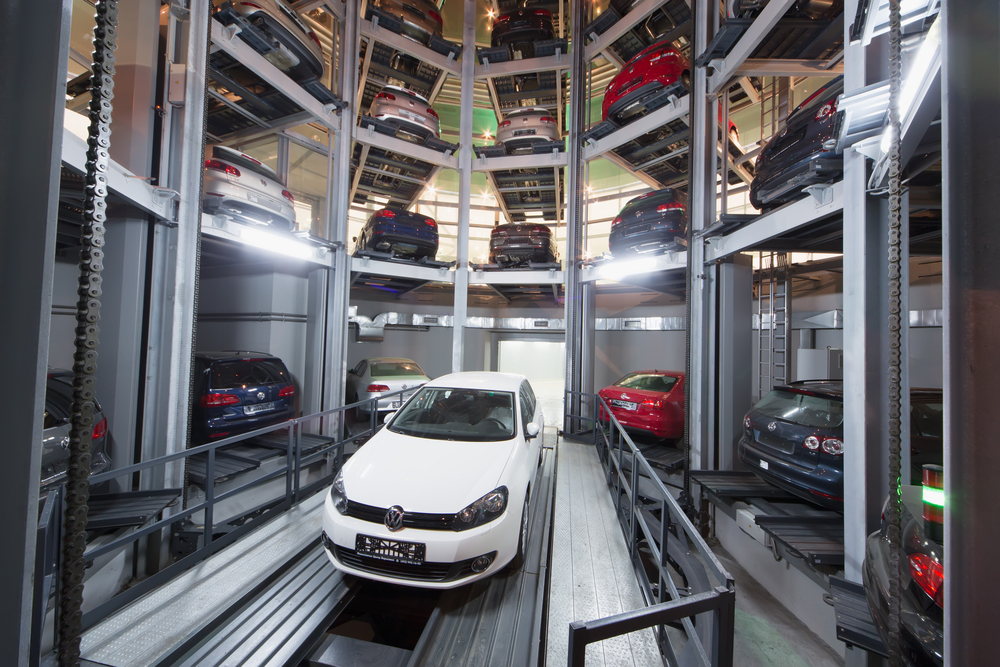
Some of the most expensive land inside modern cities is still being used to store inactive vehicles for hours every day. Parking garages, ramps, and surface lots occupy prime areas inside business districts, airports, residential towers, and shopping centers while cities continue struggling for more housing, commercial expansion, and public space.
Autonomous parking robots are becoming part of a larger conversation around urban efficiency and land usage. The global automated parking system market is already valued at more than $3 billion, according to Research and Markets. Rising property prices, increasing urban density, and pressure on city infrastructure are pushing developers and planners to rethink how parking space is designed and managed.
Space Efficiency Problem
Traditional parking systems are built around human driving behavior. Vehicles need turning space, ramps, circulation lanes, ventilation systems, and access areas so drivers can move comfortably through garages. The result is an inefficient use of land, especially in dense urban areas where property values continue rising.
Autonomous parking robots reduce much of that wasted space because vehicles can be stored in tighter layouts without requiring large human-access zones. Several automated parking systems now report significantly higher parking density compared to traditional garages because unnecessary circulation areas are removed.
Large sections of valuable urban land are still functioning mainly as storage space for inactive vehicles. At the same time, cities are demanding more apartments, office capacity, retail activity, and public infrastructure. Developers are increasingly looking at parking as a land efficiency problem instead of only a transportation requirement.
Smart Parking Investments
Automated parking systems are attracting attention because they allow buildings to use space more efficiently. Traditional parking structures generate lower long-term value compared to apartments, offices, hotels, retail zones, or mixed-use developments.
By reducing ramps and vehicle circulation areas, automated parking systems create more usable commercial space inside the same property footprint. This becomes especially important in regions where land prices continue climbing and large-scale urban projects are expanding quickly.
Research published by Research and Markets identifies Asia-Pacific as one of the fastest-growing regions for automated parking adoption because of rapid smart city investments and increasing urban density. Cities across Asia, Europe, and the Middle East are already integrating digital parking systems into larger mobility and infrastructure projects.
Parking is becoming part of commercial planning, land optimization, and operational efficiency instead of remaining a background utility inside real estate projects.
Digital Infrastructure System
Parking systems are increasingly being managed through software platforms powered by occupancy analytics, IoT sensors, automated payment systems, AI-assisted traffic coordination, and digital reservation tools.
The global smart parking market was valued at approximately $6.3 billion in 2025 and is projected to continue expanding steadily over the next decade, according to market intelligence data published by Yahoo Finance Markets Data.
Roads, charging stations, traffic systems, and parking facilities are increasingly operating as connected digital networks instead of isolated physical structures. Parking is gradually becoming part of the operational software layer of modern cities. That changes how infrastructure is monitored, optimized, and monetized.
Future EV Parking
Electric vehicles are adding another layer to parking infrastructure because parking facilities are increasingly functioning as charging and energy management hubs. Many automated parking systems now integrate EV charging infrastructure directly into parking operations, allowing vehicles to be parked, charged, and retrieved through coordinated digital systems.
Industry estimates published by Intel Market Research suggest automated parking systems can reduce vehicle circling and idling behavior by 60% to 75% compared to conventional parking environments.
Drivers in crowded districts often spend a surprising amount of time searching for parking. The fuel waste, congestion pressure, and productivity loss created by that inefficiency quietly affect the broader urban economy every day.
Autonomous parking robots are gaining importance because cities are beginning to question how much economic value is lost through inefficient parking systems and poorly utilized urban space.
Conclusion
Autonomous parking robots are drawing attention because they expose how inefficient urban land usage has become. Parking is no longer only connected to transportation. It now affects real estate value, infrastructure planning, congestion management, commercial land usage, and operational efficiency.
Cities focused heavily on helping vehicles move faster. The larger challenge now is using urban space more intelligently. That change affects how developers design projects, how infrastructure investments are planned, and how valuable land inside major cities is ultimately used.
As urban density continues increasing, parking is becoming less about storing vehicles and more about managing limited space inside increasingly expensive cities.
Frequently Asked Questions
1. What are autonomous parking robots?
Autonomous parking robots are automated systems that move and park vehicles inside parking facilities without human driving inside the structure. They use sensors, software systems, and robotic platforms to optimize parking space and vehicle movement.
2. Why are cities investing in automated parking systems?
Cities are facing rising land costs, traffic congestion, and space limitations. Automated parking systems help increase parking capacity, reduce wasted space, and improve land efficiency in dense urban areas.
3. How do autonomous parking robots help real estate developers?
Automated parking systems reduce the amount of space needed for ramps and vehicle circulation. This allows developers to use more of a property for apartments, offices, retail spaces, or other revenue-generating areas.
4. Are autonomous parking systems connected to EV infrastructure?
Yes. Many modern automated parking facilities now integrate EV charging systems directly into parking operations, allowing vehicles to be parked, charged, and retrieved through coordinated digital systems.
5. Can automated parking systems reduce traffic congestion?
Automated parking systems help reduce vehicle circling and idling inside crowded districts by improving parking efficiency and real-time space management. This can lower fuel waste and reduce pressure on urban traffic flow.