
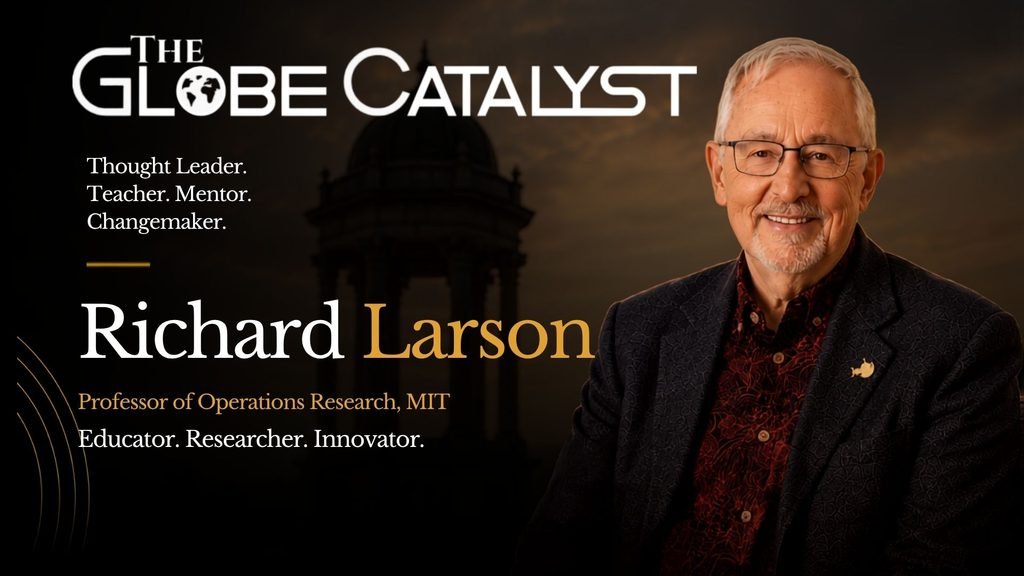
A lifetime of turning complex systems, difficult decisions, and real-world challenges into opportunities for better thinking, better learning, and better outcomes
For Professor Richard C. Larson, some of the most important questions in life are not solved by theory alone. They require curiosity, critical thinking, observation, and—perhaps most importantly—a willingness to step beyond the classroom and understand how systems actually work in the real world.
Throughout his career, Larson has combined rigorous Operations Research with practical engagement in public systems and industry. Yet what distinguishes his perspective is not simply his ability to build sophisticated mathematical models. It is his conviction that meaningful knowledge must ultimately connect with practice and with the people who depend on the systems being studied.
Looking back on his professional journey, Larson identifies both his methodological contributions and their implementation in practice as sources of particular pride. Among the work closest to that legacy is the Hypercube Queueing Model and its approximation, developed to address the complex challenge of spatially distributed emergency response involving police and emergency medical resources.
The work illustrates a central theme of his career: real-world systems can be extraordinarily complex, but complexity should not become an excuse for avoiding rigorous analysis.
Turning Complexity into Practical Understanding
Larson’s work has been motivated by a straightforward but consequential question: How can public safety organizations scientifically determine how best to deploy their limited resources?
For him, Operations Research is not merely an academic exercise. It is a way of bringing disciplined analysis to decisions that can affect how services operate in the real world.
His contributions have included the Hypercube Queueing Model and its approximation, work involving square-root laws in emergency response, efforts to improve the deployment and scheduling of human resources in New York City’s 911 emergency call center, and the creation of organizations designed to bring systems analysis into practice. He also regards his work supervising the graduate research careers of many MIT master’s and doctoral students as an important part of his contribution.
The Hypercube Queueing Model was particularly significant because, in Larson’s view, it established his reputation as a modeler capable of efficiently and effectively creating mathematical models for systems whose state spaces can grow exponentially as the number of servers increases.
But Larson’s philosophy has never been limited to equations.
He describes himself proudly as a “Boots on the Ground Guy.” For him, working directly with practitioners has been one of the most valuable aspects of his career. Those experiences have given him a deep respect for the knowledge, judgment, and professionalism of people working inside the systems that researchers seek to understand.
The Human Side of Decision-Making
One of Larson’s most compelling insights is that decision-making cannot be understood solely through data.
Drawing on a definition attributed to Professor Ronald Howard of Stanford, Larson views a decision as an irrevocable allocation or deployment of resources. The difficulty, he argues, is that many organizations are not equipped with internal experts capable of dealing with system models involving probabilistic behavior and nonlinear responses to redeploying resources.
Over time, his own thinking evolved.
While his early work was strongly quantitative, Larson gradually broadened his interests to include behavioral and psychological dimensions. That evolution is particularly important in his work on queues. A waiting line may be mathematically measurable, but the human experience of waiting can be equally important.
His professional nickname, “Dr. Queue,” reflects his longstanding interest in queueing systems. Yet Larson’s understanding of queues eventually expanded beyond calculating waiting times. He came to recognize that the psychology of waiting can sometimes matter as much as—or even more than—the mathematical duration of the wait.
This broader perspective reveals something fundamental about Larson’s approach: systems are ultimately created for people, and therefore people must remain part of the analysis.
Data, Technology, and the Next Era of Decision Science
Larson believes data, technology, and analytical thinking are already vital to organizational success. He points to American Airlines as an example of an organization in which Operations Research specialists have played important roles across many aspects of operations.
But when looking toward the future, Larson sees one development standing apart from the rest: artificial intelligence.
Interestingly, he questions the terminology itself.
Rather than “Artificial Intelligence,” Larson suggests the term “Automated Intelligence,” arguing that many systems being developed today involve sophisticated human-programmed software capable of making repeated decisions within structured environments. He points toward applications already emerging in transportation, inventory management, and personnel scheduling.
His perspective suggests that the most meaningful question surrounding AI may not be whether machines can imitate human intelligence. Instead, it may be where structured, repetitive decision-making can responsibly be supported—or automated—while human judgment remains essential for complex and changing circumstances.
A Teacher’s Greatest Measure of Success
For Larson, however, professional achievement is not measured only through models, research papers, or institutional accomplishments.
Mentoring students has been among the most rewarding aspects of his professional life.
His message to students is remarkably optimistic: almost every student can truly excel when provided with appropriate guidance and motivation.
He believes future leaders and researchers must develop deep critical-thinking skills—the ability to examine two or more sides of an argument within their own minds and determine an appropriate course of action.
For students pursuing Operations Research, analytics, or decision science, Larson’s advice extends beyond simply earning good grades. He encourages learners to discover how they personally learn difficult subjects, from highly conceptual and theoretical material to practical problems requiring “Boots on the Ground” experience.
The objective, in his view, is to become a modern-day craftsperson—someone whose knowledge is not temporarily stored for an examination but becomes a lasting professional capability.
Leading by Doing
Larson’s leadership philosophy is concise:
“Leadership is shown by example.”
For him, leadership means successfully doing the work and demonstrating the standards that encourage others to follow.
It is a philosophy that connects naturally with his practical approach to research and education. Rather than separating intellectual work from implementation, Larson has consistently emphasized the value of understanding real systems and engaging with practitioners.
His own professional decisions, he says, have generally been guided by merit and by the importance of the available options. He attributes some of this to having spent his professional life at MIT, where he describes major decisions as being grounded in a meritocratic environment.
Thinking Beyond the Expected Path
Larson’s intellectual journey also demonstrates the value of remaining open to unexpected directions.
His work began with a strong emphasis on quantitative Operations Research. Yet his interests expanded into psychology, behavior, education, public systems, and other dimensions of complex human environments.
That willingness to change perspective has remained central to his philosophy.
For the next generation, his advice is simple: “The answer is not the answer, the process is the answer.” Question the path you are traveling, explore alternatives, and make midcourse corrections when circumstances warrant them.
It is advice that applies equally to researchers, entrepreneurs, executives, students, and anyone confronting a complex problem.
Beyond One Lifetime
Larson hopes his work will have an impact that extends beyond his own lifetime.
His scholarly papers represent only one dimension of that ambition. He points instead to educational initiatives such as MIT BLOSSOMS—Blended Learning Open-Source Science or Math Studies—as an example of how knowledge can be transformed into resources that continue reaching learners and teachers.
This reflects a deeper philosophy about knowledge: its value increases when it can be passed forward.
For Larson, the objective of education is not simply to help someone pass a test. Knowledge should remain useful throughout a person’s life and improve that person’s ability to understand and navigate the world.
The “Boots on the Ground” Scholar
There is perhaps no better way to understand Larson’s professional identity than through his own description of himself as a “Boots on the Ground Guy.”
The phrase captures an approach that has defined his work: build the model, but understand the system; analyze the data, but listen to the practitioners; teach the theory, but show why it matters; solve the immediate problem, but remain curious about the larger one.
His curiosity remains active because, as he puts it, the World itself keeps providing questions.
He views humanity’s collective scientific knowledge as only a small fraction of reality and continues to seek out new ideas in science, technology, and social science.
That intellectual curiosity may ultimately be one of his most enduring qualities.
A Future Built on Curiosity and Responsibility
When Larson looks at the next 10 to 20 years, his concerns extend far beyond technology.
He hopes humanity can avoid major wars, reduce smaller conflicts, remain vigilant against emerging contagions, and build societies that embrace a multicultural world in which different opinions, cultures, and religions are accepted and respected.
He also believes universities, businesses, and governments must recognize their interdependence. Rather than operating in isolation, leaders across these institutions should understand that each is an important part of the broader American system.
For future innovators, his message is therefore not simply about acquiring more technical knowledge.
It is about questioning assumptions.
It is about remaining adaptable.
It is about developing the ability to think critically.
And above all, it is about pursuing meaningful intellectual passions.
The Advice That Endures
If Larson could offer one piece of advice to his younger self, it would be straightforward:
Stay the course. Believe in yourself. Be truthful to yourself.
His advice to future generations is equally powerful.
Find your intellectual passion and pursue it with all the energy you can muster. But recognize that one passion may last only a few years. A fulfilling lifetime, he suggests, may require discovering a sequence of new passions.
That willingness to remain curious—to keep learning, questioning, adapting, and exploring—is perhaps the clearest thread connecting Larson’s career.
His legacy is therefore not confined to a particular mathematical model, research contribution, classroom, or institution.
It lives in a way of thinking.
A way of approaching difficult problems with rigor while remaining attentive to the people affected by them.
A way of teaching that seeks to turn temporary knowledge into lifelong capability.
And a way of living professionally that continues to ask the essential questions that lead to deeper understanding, better decisions, and meaningful solutions.