
What does it take to make a difficult decision work in the real world?
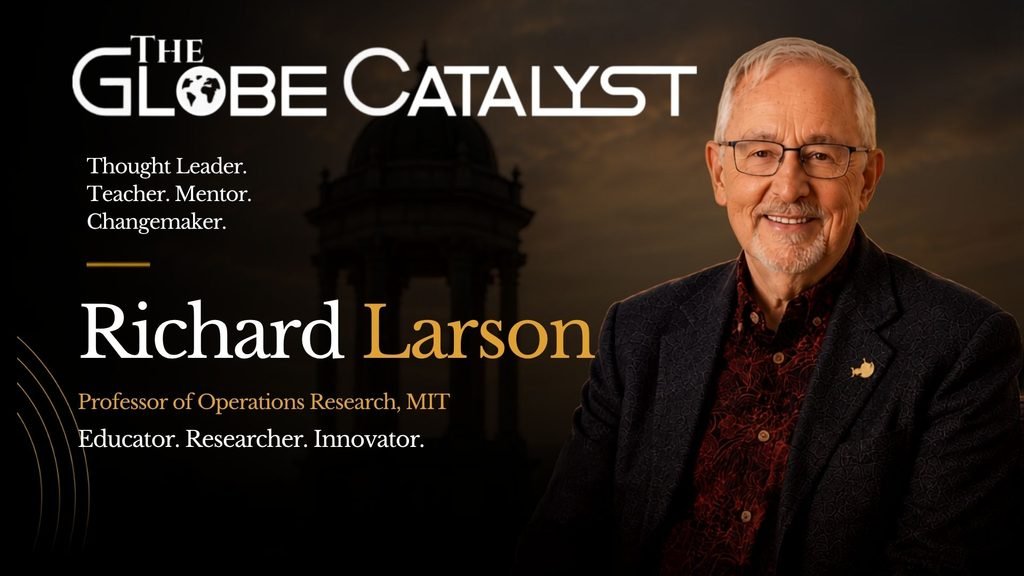
For Professor Richard C. Larson, the answer often begins with understanding the system behind the decision. At MIT, his work in Operations Research has connected mathematical analysis with public safety, emergency response, queueing, education and the practical challenges organizations face every day.
Larson’s work has never been limited to equations. His research includes the Hypercube Queueing Model and its approximation, along with work on emergency response and resource deployment. He has also worked directly with practitioners, developing a strong interest in how complex systems function outside academic settings.
But what happens when the numbers do not tell the whole story?
That question became increasingly important in his work on queues. Larson’s interests expanded from strictly quantitative Operations Research toward behavioral and psychological aspects, leading him to look at how people actually experience waiting rather than simply measuring it.
The same practical thinking appears in his view of decision-making. Larson argues that many organizations are not equipped to handle systems involving probability and nonlinear responses when resources are moved or redeployed. Better decisions, in his view, depend on understanding how a system behaves — not just collecting more data.
His approach also explains his preference for being close to the people operating a system.
Larson describes himself as a “Boots on the Ground Guy,” reflecting the value he places on working directly with practitioners and learning from their experience.
What does that mean for today’s technology?
Larson prefers the term “Automated Intelligence” when referring to software systems that repeatedly make decisions in structured environments. He points to transportation, inventory management and personnel scheduling as areas where automation can already support complex operations. His perspective keeps the focus on a practical question: where can technology strengthen decision-making, and where does human judgement remain essential?
Education offers another side of his work.
Larson considers mentoring students one of the most rewarding parts of his professional life. He encourages critical thinking and learning that remains useful beyond examinations, a philosophy that also influenced his involvement with MIT BLOSSOMS and technology-supported education.
For him, knowledge has value when people can carry it into their work and lives.
Curiosity continues to play a major role in that outlook. Larson remains interested in science, technology and social science and encourages future professionals to question assumptions, explore alternatives and stay open to new intellectual interests.
About Professor Richard C. Larson
Professor Richard C. Larson is Professor (Post-Tenure) of Engineering Systems at the Massachusetts Institute of Technology and a researcher in Operations Research, decision science and complex systems. His areas of expertise include queueing theory, psychology of queueing, public and private service systems, transportation and logistics, workforce analysis, and technology-enabled learning. He is widely known for his research on queueing theory and is often referred to as “Dr. Queue.”
At MIT, Larson has also contributed extensively to graduate research and education, including work connected with the MIT Operations Research Center and technology-enabled learning initiatives. His work combines mathematical modeling with practical applications across public and private systems.