
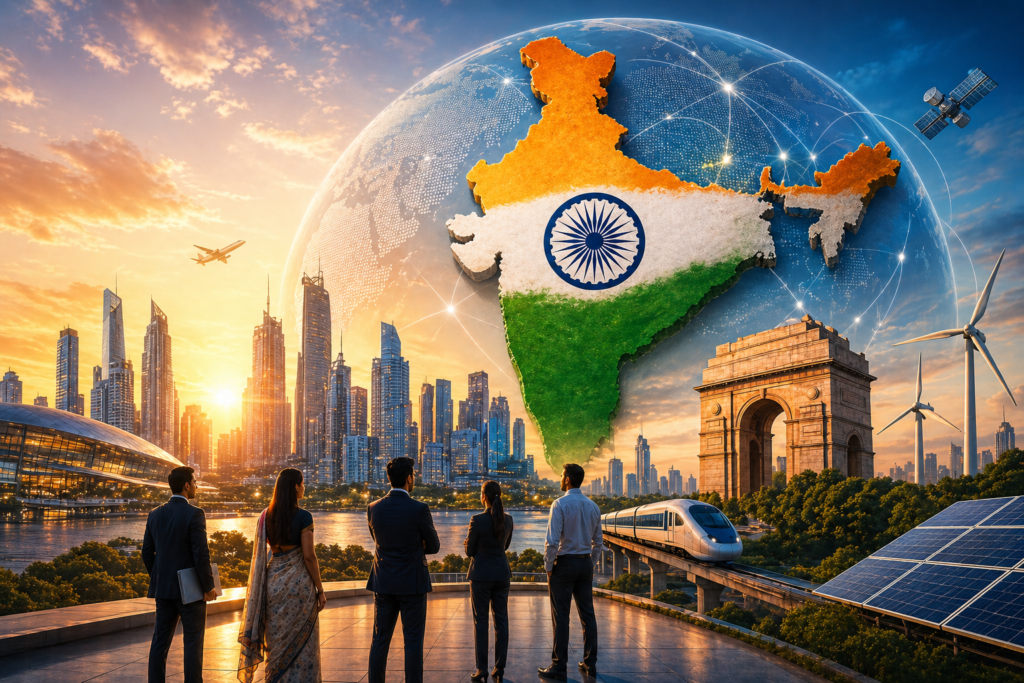
India’s economy is now worth around $4.1 trillion, making it one of the largest in the world. It is among the top six global economies and is growing faster than most of them. While many major economies are expanding at around 2 to 3 percent, India is growing close to 6.5 percent in 2026, making it the fastest-growing large economy today.
India was once treated mainly as a support market. Today, it is becoming a place where companies are building long-term operations, expanding production, and planning future investments. India is steadily moving toward becoming a global business hub, as companies are now including it in their long-term plans more than before.
8 Key Reasons Behind India’s Rise as a Global Hub
1. Large Consumer Market
India has a population of more than 1.4 billion people, and consumption is growing across income levels. Household spending has increased steadily over the last decade, with more people moving into middle-income groups. This is visible in sectors like smartphones, digital payments, financial services, and retail. Demand is no longer limited to major cities. Tier-2 and tier-3 cities are contributing strongly to growth, which gives companies access to a wider and more stable customer base. Also India offers both production scale and a large market to sell into.
2. Strong Economic Growth
India continues to grow at around 6 to 7 percent annually, even when global growth remains close to 3 percent. This level of growth is supported by domestic demand, government spending, and private investment. The economy has remained relatively stable during global disruptions, which makes it more predictable for long-term planning. A growing economy also creates more opportunities across sectors such as infrastructure, manufacturing, and services, attracting both domestic and international investors.
3. China+1 Supply Chain Shift
Global companies are reducing their dependence on a single country for manufacturing and sourcing. This has led to a shift toward multiple production locations. India has become one of the preferred destinations for this diversification. Large electronics and manufacturing companies have started expanding their presence in India by setting up factories and increasing production capacity. Smartphone production has grown rapidly, and a significant share of global devices is now being assembled in India. This shift shows how companies are now spreading production across countries instead of depending on one place. Companies like Foxconn and Tata Electronics are expanding manufacturing in India as part of this shift.
4. Rising Foreign Investment
India has attracted strong foreign investment over the years, with cumulative inflows crossing $1 trillion. Investment continues across sectors such as technology, infrastructure, manufacturing, and financial services. Global companies are setting up offices, research centers, and production units, showing long-term commitment. The steady flow of capital reflects confidence in India’s growth potential and economic stability. It also supports job creation and expansion of industries within the country. Companies like Apple have already increased production in India, showing that this shift is real.
5. Digital Infrastructure Growth
India has developed one of the largest digital ecosystems in the world. Digital payment systems handle billions of transactions every month, and internet penetration continues to expand rapidly. Businesses can reach customers, process payments, and verify identities at scale with relatively low cost. This digital setup has made it easier for companies to operate efficiently and expand quickly. It has also enabled the growth of startups and digital services across sectors such as finance, e-commerce, and healthcare.
India’s growth also stands out because of how it has built its digital systems early. Payments, identity, and online services are already working at a large scale. This makes it easier for companies to enter the market and expand faster compared to many other growing economies.
6. Government Policy Support
Policy changes have played a key role in improving the business environment. The government has introduced initiatives like production-linked incentives (PLI) to support manufacturing and attract global companies. Tax reforms and simplified compliance systems have reduced barriers for businesses. Foreign investment rules have also been relaxed in several sectors. These steps are aimed at creating a more stable and predictable environment for companies looking to invest and expand in India.
7. Manufacturing Expansion
India is strengthening its position in manufacturing, especially in sectors like electronics, automotive, and industrial goods. India has become one of the largest smartphone manufacturing hubs, with exports growing fast in recent years. Companies are not only assembling products but also building supply chains and increasing local production. Industrial corridors and infrastructure projects are supporting this expansion. A stronger manufacturing base helps India participate more actively in global trade and reduces dependence on imports over time. Companies like Tata Electronics and global players such as Micron Technology are also investing in manufacturing and semiconductor-related projects in India.
8. Global Strategic Importance
The global economy is shifting toward a multi-country model where companies spread operations across regions to reduce risk. India fits into this approach due to its size, growth, and improving business environment. Companies are now treating India as a core part of their global plans, not just an optional market. Its position in global trade, growing economy, and expanding infrastructure make it an important location for companies looking to balance growth and stability.
Key Challenges India Faces as a Global Hub
India is growing fast and attracting global companies, but becoming a true global business hub also means solving some key challenges. These challenges do not stop growth, but they do affect how fast companies can expand.
- Infrastructure gaps across regions
Infrastructure has improved in major cities and industrial corridors, but it’s still uneven across the country. Some areas have strong connectivity and logistics, while others face delays in transport, weak road networks, and limited industrial support. - Skill gap in the workforce
India has a large working population, but there is a gap between available talent and industry requirements. Many companies need to invest heavily in training before employees become fully productive. - Dependence on imported components
India still depends on imports for key parts, especially in electronics and advanced manufacturing. This limits its ability to become a fully independent production hub. - Regional imbalance in development
Economic growth is concentrated in a few states like Maharashtra, Karnataka, and Tamil Nadu, while other regions are still developing. - Low investment in research and innovation
Compared to global leaders, India invests less in research and development, which slows progress in advanced industries. - Pressure on small and informal businesses
Small businesses often face rising costs, limited access to funding, and unstable demand.
Conclusion
India is becoming a more important part of the global business landscape. Companies are no longer just exploring the market. They are investing, expanding, and building long-term operations here. This shift can be seen in how businesses are changing their strategies and where they are placing their future focus.
Growth is strong, but how well India improves infrastructure, skills, and execution will decide how far it can go. The opportunity is clear, and the interest is already there. What matters now is how consistently this progress is maintained over time.
India offers scale, growth, and long-term opportunity. If this direction continues, it will become one of the key places where global companies build their future.
Frequently Asked Questions
1. Is India really becoming a global business hub?
Yes, India is becoming a global business hub as companies increase investment and build long-term operations, supported by strong growth and market size.
2. Why are global companies investing in India?
Companies are investing in India due to its large consumer market, steady economic growth, and the need to diversify supply chains across countries.
3. Can India replace China in global manufacturing?
India is not replacing China completely, but it is becoming an important alternative as companies spread production across multiple locations.
4. What are the biggest challenges India still faces?
India faces challenges like infrastructure gaps, skill shortages, and dependence on imports, which affect how fast businesses can expand.
What industries are growing the fastest in India?
Electronics manufacturing, digital services, and infrastructure are among the fastest-growing sectors attracting global investment in India.