
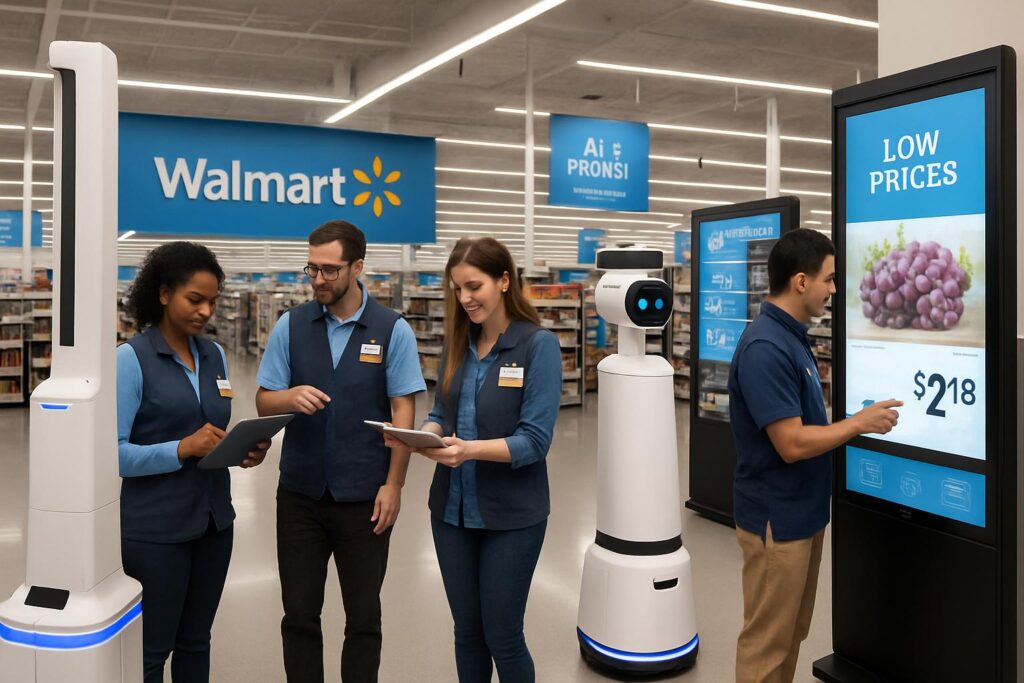
Retail transformation often happens gradually. It begins with operational improvements that appear technical on the surface but slowly reshape how the business functions. Over the past few years, Walmart has been investing heavily in automation across its supply chain and fulfillment network. What makes this important is not the technology itself, but the scale at which it is being implemented.
As the world’s largest retailer, operating more than 10,000 stores globally, Walmart functions at a scale where incremental efficiency gains can influence billions of dollars in annual performance. Investor updates and industry reporting through 2025 and early 2026 indicate measurable progress in automation across distribution centers and e commerce fulfillment. Nearly half of online order volume now moves through automated facilities, and close to 60 percent of U.S. stores receive inventory from automated distribution centers. The company has outlined a target of roughly 65 percent store automation coverage by 2026.
These numbers reflect more than operational upgrades. They indicate a shift in how large scale retail is being structured for the long term.
Reworking the Cost Structure of Retail
Retail margins leave little room for inefficiency. Historically, scale and supplier leverage were the primary tools for cost control. Walmart’s automation investments suggest that operational throughput is becoming equally important.
Industry coverage shows that automated fulfillment centers can reduce per unit handling costs by approximately 20 to 30 percent compared with traditional manual sites. Shipping expenses in automated segments have declined in double digit percentages, supported by improved routing and tighter fulfillment density. Inventory growth has also remained controlled relative to sales growth, reflecting stronger demand forecasting and replenishment discipline.
When operating income begins to grow faster than revenue in a mature retail business, it often signals structural cost improvements rather than temporary sales spikes. In this context, automation appears closely tied to margin stability and long term efficiency.
For companies observing this pattern, the lesson is practical. Efficiency gains that compound at scale can influence financial resilience more than short term expansion alone.
The Changing Role of the Physical Store
Walmart’s stores are gradually evolving beyond their traditional role as sales floors. Many now function as localized fulfillment nodes within a broader omnichannel network.
Recent earnings commentary noted that a meaningful portion of store fulfilled online orders are delivered within three hours. Achieving that level of speed depends on coordinated inventory tracking, streamlined picking processes, and redesigned backroom operations. Digital handheld devices used by more than one million U.S. associates provide real time visibility into stock location and availability.
This integration reduces the gap between inventory and customer demand. Instead of separating warehouse and retail functions, Walmart increasingly connects them within a unified operational model.
For retail operations more broadly, this approach redefines how physical infrastructure contributes to digital growth.
Systems That Coordinate the Network
Automation hardware alone does not create lasting efficiency. Consistent performance depends on coordination across systems.
Walmart has expanded the use of demand forecasting tools, product catalog management systems, and internal digital platforms to improve accuracy and reduce friction. Industry reporting in 2025 highlighted that hundreds of millions of product data points were processed to enhance catalog precision and search quality. Improved forecasting reduces excess inventory while minimizing stockouts.
When forecasting connects directly with warehouse systems, transportation planning, and store level inventory data, the enterprise responds more smoothly to shifts in demand. Variability decreases, and operational decisions become more predictable.
This pattern suggests that the effectiveness of automation depends largely on how well it is integrated into broader operational systems.
Workforce Structure in Transition
Automation also influences workforce structure. Walmart acknowledged targeted restructuring in repetitive operational roles during 2025 while expanding reskilling initiatives. Roles such as system monitors, robotics maintenance specialists, and operational coordinators are becoming more common.
The widespread use of digital tools indicates a gradual shift toward technology enabled retail work. Tasks increasingly involve interpreting system outputs, managing exceptions, and coordinating processes rather than repetitive manual activity.
In large retail networks, even incremental adjustments to job design can influence broader workforce expectations across the sector.
Competitive Implications
Walmart’s capital investment in supply chain automation has been concentrated over the past two years. As this infrastructure matures, the company operates with a cost base supported by automated distribution centers, integrated store fulfillment, and data driven planning systems.
Retailers relying primarily on manual processes may experience widening cost differences over time. When one operator reduces handling costs significantly while improving delivery speed, pricing flexibility and margin resilience naturally shift.
Industry analysts have noted that automation gaps within grocery and general merchandise retail could influence competitive positioning in the coming years.
Signals for the Future of Retail Operations
Several patterns emerge from Walmart’s recent trajectory.
1. Operational efficiency is being treated as a long term structural priority rather than a temporary improvement initiative.
2. Stores are evolving into multifunctional assets within an integrated retail network.
3. Forecasting accuracy and data visibility are becoming central to supply chain performance.
4. Workforce models are gradually adapting to more system oriented responsibilities.
These patterns are visible not through marketing narratives, but through capital allocation decisions, fulfillment metrics, and financial performance indicators reported over the past year.
Conclusion
Walmart’s automation strategy reflects a measured redesign of retail operations. By adjusting fulfillment processes, integrating store networks, and strengthening data coordination, the company is reshaping how scale translates into efficiency.
The broader implication for retail organizations is subtle but meaningful. Long term competitiveness may increasingly depend on how well operational systems are connected, measured, and refined over time.
In an industry defined by tight margins and high customer expectations, structural discipline often determines resilience. Walmart’s recent trajectory provides a detailed example of how that discipline can be embedded directly into the operating model.