
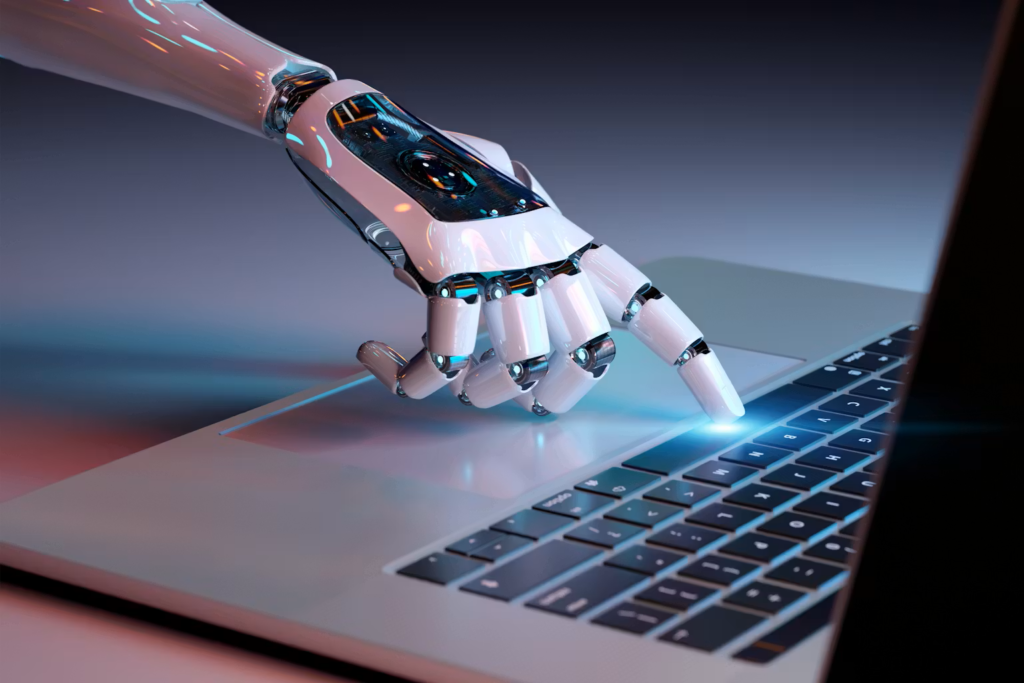
Most conversations about artificial intelligence have stayed inside screens. Businesses invested heavily in chatbots, copilots, content tools, and automation software that could summarize documents, generate code, or answer questions in seconds. These systems changed office work, but they remained digital. They could process information, yet they could not physically interact with the world around them.
Physical AI is becoming one of the most important business stories of 2026 because it moves intelligent systems beyond software and into the real world.
What Is Physical AI?
Physical AI refers to intelligent systems that can understand their surroundings, make decisions, and perform physical tasks in real-world environments. Instead of only generating information, these systems can move through warehouses, inspect factories, avoid obstacles, identify damaged products, monitor infrastructure, and work alongside people.
Unlike traditional industrial machines that simply follow fixed instructions, these systems can react to changing conditions in real time. They combine robotics, sensors, computer vision, machine learning, and real-time processing to help machines operate more independently and more effectively.
In simple terms, traditional automation repeated tasks. Physical AI allows machines to understand what is happening around them and respond accordingly.
The Demand for Physical AI
Companies are dealing with rising labor costs, worker shortages, supply chain instability, and growing pressure to improve productivity. Warehouses, factories, logistics centers, and industrial maintenance teams are finding it harder to hire enough people for repetitive or physically demanding jobs.
A recent Capgemini report found that 79 percent of organizations are already exploring, piloting, deploying, or scaling Physical AI. Around 27 percent are already in deployment mode, while two thirds of companies now say it is a high priority for the next three to five years. These numbers show that Physical AI is no longer a futuristic idea. It is becoming part of mainstream business strategy.
The Evolution of Automation
Industrial machines were built to repeat the same task in the same environment. They were efficient, but only if everything stayed predictable. If an object moved, a product was damaged, or a worker stepped into the wrong place, the system could fail.
Machines can now recognize objects, avoid obstacles, detect defects, predict maintenance issues, and respond to changing conditions in real time. The real shift is not about machines becoming stronger or faster. It is about them becoming more flexible, responsive, and capable of adjusting to changing situations.
Many businesses may find the biggest opportunity in solving small but expensive operational problems. A warehouse robot that reduces walking time or an inspection robot that prevents a costly machine failure may create more value than a flashy humanoid robot.
Industries Adopting Physical AI
Manufacturing is one of the industries changing fastest because production lines can no longer depend only on repetitive machines. Companies are now using industrial robotics for predictive maintenance, quality control, defect detection, and more flexible assembly lines. Manufacturers are increasingly using these systems to reduce downtime, improve quality control, and lower operating costs.
Warehousing and logistics may become even bigger opportunities because speed, efficiency, and labor shortages are creating constant pressure. Amazon already operates more than 750,000 robots across its fulfillment network, showing how large companies are beginning to treat warehouse automation as a long-term business advantage rather than an experiment.
Beyond warehouses, Physical AI is also expanding into healthcare, utilities, construction, mining, and infrastructure. Robots are increasingly being used to inspect power grids, pipelines, dangerous industrial environments, and construction sites where sending people is risky or expensive.
China and the Future of Robotics
One of the biggest stories inside Physical AI is happening in China. Chinese companies are moving faster than many Western competitors because they have lower manufacturing costs, stronger supply chains, government support, and the ability to produce new robotics hardware more quickly.
Research shows that Chinese robot makers are already shipping far more humanoid robots than many American rivals while offering products at significantly lower prices. Some Chinese robotics companies are already producing humanoid systems at a fraction of the cost of many Western rivals, giving them an important early advantage.
The future of Physical AI is not just a technology story. It is also becoming a geopolitical story about who controls the next generation of robotics, manufacturing, and industrial productivity.
Conclusion
Physical AI is still in its early stages, but the direction is becoming clear. The next industrial revolution will happen on factory floors, inside warehouses, across supply chains, and in industrial environments where machines are learning how to move, respond, and work alongside people.
The companies that succeed in this space may not be the ones building the flashiest humanoid robots. They may be the ones solving simple but expensive operational problems that businesses have struggled with for years.
For readers interested in women’s leadership, workplace challenges, career growth, and the changing role of women in business and society, Chief She Leaders features articles, news, and content focused on women entrepreneurs, leadership journeys, career stories, gender issues, and the future of women in the workplace.
Frequently Asked Question
1. What is the difference between Physical AI and traditional automation?
Traditional automation follows fixed instructions and works best in predictable environments. Physical AI can understand surroundings, react to changes, and make decisions in real time.
2. Which industries are using Physical AI the most?
Manufacturing, warehousing, logistics, healthcare, construction, and infrastructure are among the biggest users of Physical AI today because these industries rely heavily on repetitive or dangerous physical work.
3. Will Physical AI replace human workers?
Physical AI is more likely to replace repetitive and physically demanding tasks rather than entire jobs. Most companies are using it to solve labor shortages and improve productivity.
4. Why is China becoming important in Physical AI?
China has lower manufacturing costs, strong supply chains, government support, and faster robotics production, which is helping Chinese companies move ahead in this market.
5. Why are businesses investing in Physical AI now?
Businesses are facing labor shortages, rising costs, and supply chain challenges. Physical AI helps companies improve efficiency, reduce downtime, and automate difficult physical tasks.