
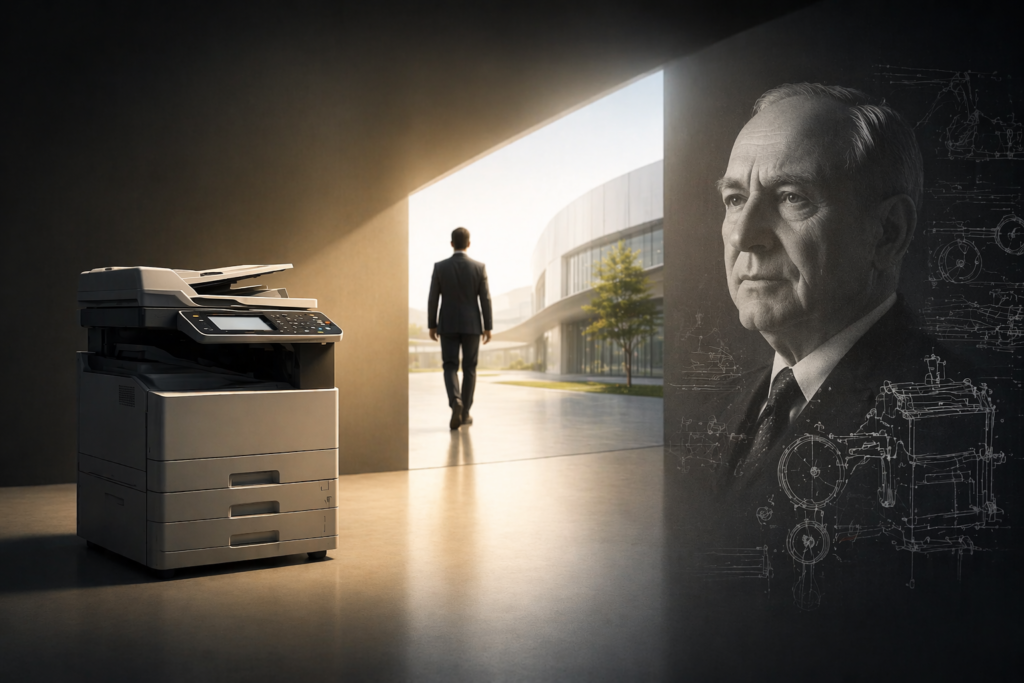
Few companies have shaped modern technology as deeply as Xerox, yet very few people remember it that way. It helped create many of the technologies people now use every day, yet most people never think of Xerox when they open a laptop, move a mouse, connect to a network, or save a file.
Most people associate the company with photocopiers and office printers. That is understandable because it built one of the most successful office equipment businesses in the world. The problem is that the same business also created much of the foundation for modern computing and never fully benefited from it.
Very few companies have ever had so much influence over the future while receiving so little credit for it. The business did not struggle because it lacked talent, money, or imagination. It struggled because it could not move beyond the model that had already made it successful.
Xerox’s Copier Empire
The company began in 1906 as the Haloid Photographic Company, but its real breakthrough came after it commercialized xerography, a dry copying process invented by Chester Carlson. The Xerox 914 copier, introduced in 1959, changed office life in a major way. Businesses no longer had to rely on carbon paper or expensive printing setups to duplicate documents.
Demand grew rapidly, and Xerox became one of the strongest business brands in America. By the early 1970s, it controlled most of the global copier market. Its brand became so dominant that people started using “Xerox” as a verb.
With copier profits pouring in, the company had the confidence to invest in bigger ideas. In 1970, it launched the Palo Alto Research Center, better known as PARC. The goal was simple: understand what the future office might look like.
What the research team found was much bigger than office equipment.
PARC Invented Modern Computing
PARC became one of the most important research labs in technology history. The company hired scientists, engineers, and programmers who were given freedom to experiment without the pressure of delivering quick profits.
Inside PARC, researchers developed:
- Ethernet networking
- Graphical user interfaces
- Laser printing
- Bitmapped displays
- Object-oriented programming
- WYSIWYG editing
Many of these technologies later became standard across the technology industry.
The lab also created the Xerox Alto in 1973, a machine that looked remarkably similar to modern computers. The Alto included:
- A mouse
- Windows and icons
- Folder-based file organization
- Networking capabilities
- A screen-based graphical interface
- Email and document editing tools
Most people think Apple invented the modern computer experience. In reality, Xerox had already built much of it years earlier.
Looking at the Alto today, the surprising thing is not that it existed. The surprising thing is how close it already was to the computers people would eventually use years later. The PARC team was not slightly ahead of the market. It was operating in an entirely different time period.
The Alto was powerful, however the company never treated it like the center of its future. Around 2,000 units were built, mainly for internal use and universities. Xerox later launched the Xerox Star, but the system was expensive and difficult to scale. Businesses were not ready to spend that much money on a workstation, especially when cheaper alternatives were beginning to appear.
Xerox Lost the Computer Revolution
One of the most famous moments in technology history came in 1979 when Steve Jobs visited Xerox PARC. During that visit, Jobs saw the graphical interface, the mouse, networking systems, and the visual style of computing that researchers had already developed.
Jobs immediately understood what management had missed. He saw that these ideas could eventually move out of research labs and become products for ordinary people. Apple later used many of these concepts in Lisa and Macintosh. Microsoft followed with Windows.
It is easy to say the company made a bad decision, but the deeper problem was that leadership kept measuring every new opportunity against the copier business. Personal computers looked smaller, riskier, and less profitable compared to the firm’s core operations.
The business became trapped inside its own success. The copier division gave it the money to build the future, but it also made leadership too comfortable to fully commit to it.
The executives were not foolish. They were highly successful leaders who had built a giant company around paper, toner, and office machines. Their mistake was believing that the future would arrive slowly enough for them to react later.
By the time leadership realized what personal computing could become, Apple and Microsoft were already moving ahead.
The Company Still Trying to Recover
The company still exists in 2026, but it no longer has the image of a major innovation business. It is now focused on print services, digital workflow tools, restructuring efforts, and business survival.
The business reported around $7 billion in revenue in 2025, but it also posted a loss of more than $1 billion. Xerox has reduced jobs, changed leadership, and tried to reshape itself around software and services. In March 2026, Louie Pastor became CEO after Steve Bandrowczak stepped down.
Apple became one of the most valuable companies in the world. Xerox became a company trying to stay relevant.
The story feels far more relevant today than many people realize. This is not simply a story about a missed opportunity from the past. It is a warning for companies now dealing with artificial intelligence, automation, robotics, and digital transformation.
Many businesses are currently facing the same challenge this company faced years ago:
- Traditional automakers adapting to electric vehicles
- Media companies responding to AI-generated content
- Consulting firms trying to understand automation
- Banks moving toward digital finance
- Manufacturers adjusting to robotics and smart factories
The fear is always the same. Companies worry that the future could damage the business model that made them successful.
This business faced the same problem and never fully escaped it.
Conclusion
The story of Xerox is one of the clearest examples that invention alone does not guarantee success. The company had brilliant researchers, world-changing ideas, and an early view of what modern computing would eventually become. It built the blueprint for the digital world long before most businesses even understood where technology was heading.
However, leadership never fully committed to the future it created. The business kept protecting the copier division while companies like Apple and Microsoft built the next era of computing around the same ideas. Xerox had the technology, but others had the confidence to take risks, simplify the products, and turn them into something millions of people could use.
The story still matters in 2026 because many companies are now standing at a similar crossroads. The businesses that succeed will not always be the ones with the best technology or the smartest research teams. They will be the ones willing to disrupt their own business before someone else does it for them.
Frequently Asked Questions
1. What did Xerox PARC invent?
Xerox PARC developed many of the technologies that later became standard in modern computing, including the graphical user interface, the mouse, Ethernet, laser printing, object-oriented programming, and WYSIWYG editing.
2. Did Steve Jobs steal ideas from Xerox?
Steve Jobs did not steal Xerox technology. Xerox allowed Apple to visit PARC, and Jobs recognized the commercial potential of ideas that Xerox had already developed but failed to market effectively.
3. Why did Xerox fail to dominate personal computing?
The company remained focused on its copier business and did not believe personal computers would become a mass-market product. Apple and Microsoft moved faster and built simpler, more affordable products.
4. Does Xerox still exist today?
Yes, Xerox still operates in 2026. The business is now focused more on print services, digital workflow tools, and software rather than major technology innovation.
5. Why is the Xerox story still important today?
The Xerox story is still relevant because many companies face the same challenge of balancing new technology with an older business model. It shows how businesses can miss major opportunities even when they see the future coming.