
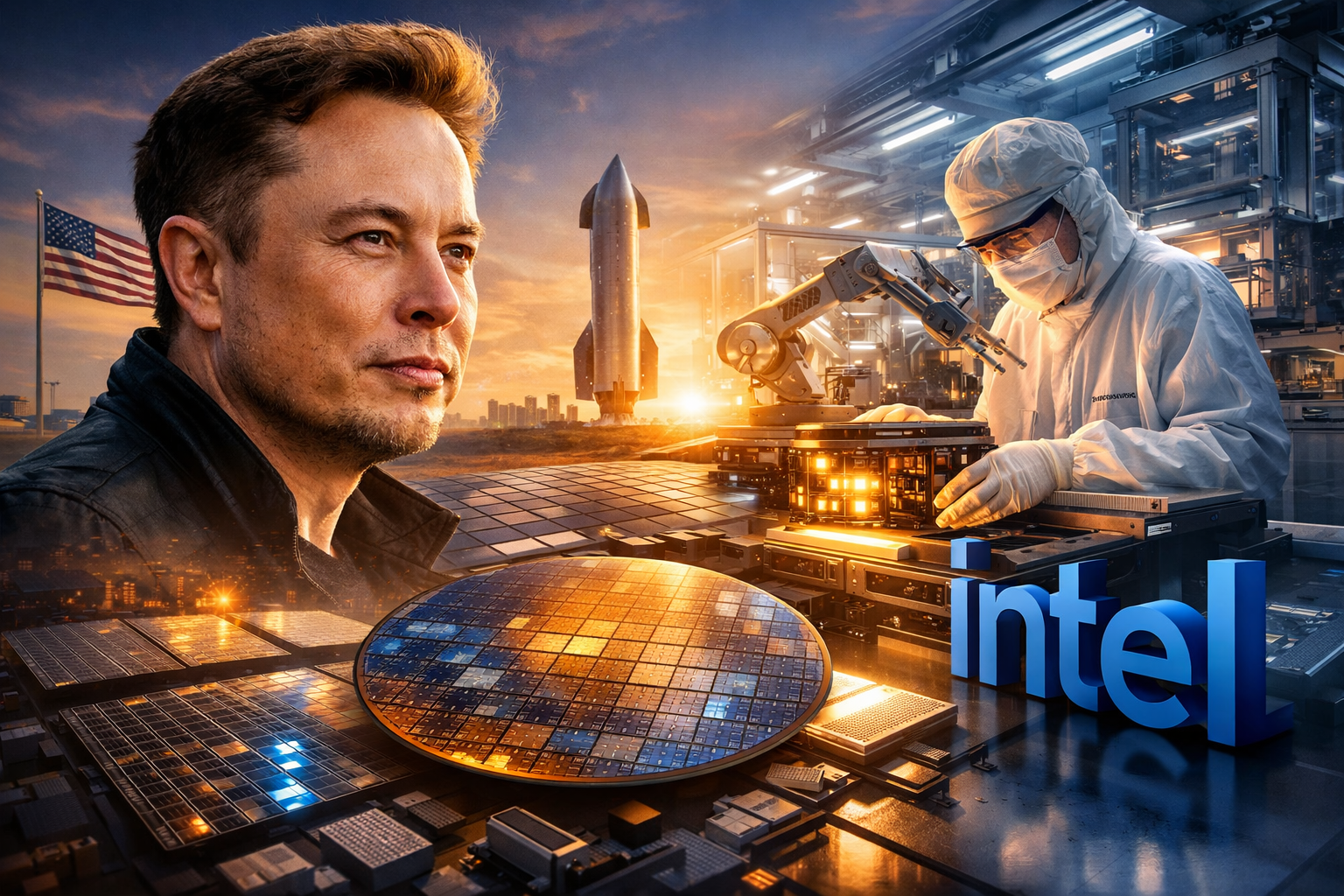
Intel has officially joined Elon Musk’s Terafab project, giving the semiconductor venture its biggest industrial partner so far and turning it into one of the most important technology stories of April 2026.
The partnership brings together Intel, Tesla, SpaceX, and xAI to build a major semiconductor manufacturing complex in Austin, Texas. The project is designed to produce advanced chips for artificial intelligence, robotics, autonomous vehicles, satellites, humanoid robots, and future data centers. Musk has said Terafab could eventually produce up to one terawatt of compute power annually, making it one of the most ambitious chip manufacturing projects ever proposed in the United States.
Terafab Emerges as a New Semiconductor Giant
Musk first introduced Terafab in March as a vertically integrated semiconductor project that combines chip design, fabrication, packaging, testing, and memory production under one system.
Today, most major technology companies still depend on different suppliers across multiple countries for each stage of chip production. That process is expensive, slow, and increasingly difficult as AI demand continues to grow.
Terafab aims to reduce that dependence by bringing more of the supply chain together in one place. The first phase of the project is expected to cost between $20 billion and $25 billion. Musk’s long-term target is 100,000 wafer starts per month in the early phase and potentially much more over time.
Intel Brings Foundry Strength to the Project
Intel’s role is important because Musk’s companies do not have experience building semiconductor operations at this scale.
Intel is expected to contribute expertise in chip design, fabrication, packaging, and large-scale production. The company’s advanced 18A manufacturing process is also expected to play a major role in helping Terafab scale faster.
Intel CEO Lip-Bu Tan recently praised Musk’s ability to reshape industries and said the semiconductor industry needs this kind of disruption. Musk also visited Intel facilities before the partnership was announced, showing that discussions between both sides had been underway for some time.
Tesla and xAI Face a Massive Chip Demand Surge
One of the biggest reasons behind Terafab is the growing chip demand inside Musk’s companies.
Tesla needs more processors for Full Self-Driving software, Cybercab robotaxis, and Optimus humanoid robots. SpaceX requires advanced chips for satellites, communications systems, and future data infrastructure. xAI also needs far more computing power to train large AI models and compete with companies like OpenAI, Google, and Anthropic.
Musk has repeatedly warned that the current semiconductor industry may not be able to keep up with future demand. Terafab is meant to give his companies more control over supply, production speed, and long-term chip access.
The Partnership Could Strengthen Intel’s Comeback
For Intel, the partnership comes at a critical time.
The company has been struggling to keep pace with Nvidia, AMD, TSMC, and Samsung in advanced chips and AI infrastructure. Intel Foundry lost around $10.3 billion across 2025, including a $2.5 billion operating loss in the fourth quarter alone. Intel’s annual revenue for 2025 came in at $52.9 billion, its weakest performance since 2010.
That is why the Terafab partnership matters so much. It gives Intel one of the highest-profile customers it has secured in years and strengthens confidence in its long-term foundry business.
The market reacted immediately after the announcement. Intel shares rose between 4% and 5%, reaching around $52.91 after the news became public. The company’s stock has already climbed 22% over the past month and 169% over the past year as investors become more optimistic about its turnaround strategy under CEO Lip-Bu Tan.
The US-China Semiconductor Battle Deepens
The bigger story behind Terafab is the growing semiconductor battle between the United States and China.
Washington is investing billions of dollars into domestic semiconductor production while tightening restrictions on advanced chip technology exports to China. Semiconductors are now viewed as a national security issue because they power AI systems, defense technology, robotics, satellites, cloud computing, and future industrial infrastructure.
Intel joining Terafab shows that the next phase of the AI race will not only be about software. It will also be about factories, supply chains, manufacturing, and control over the world’s most advanced chips.