
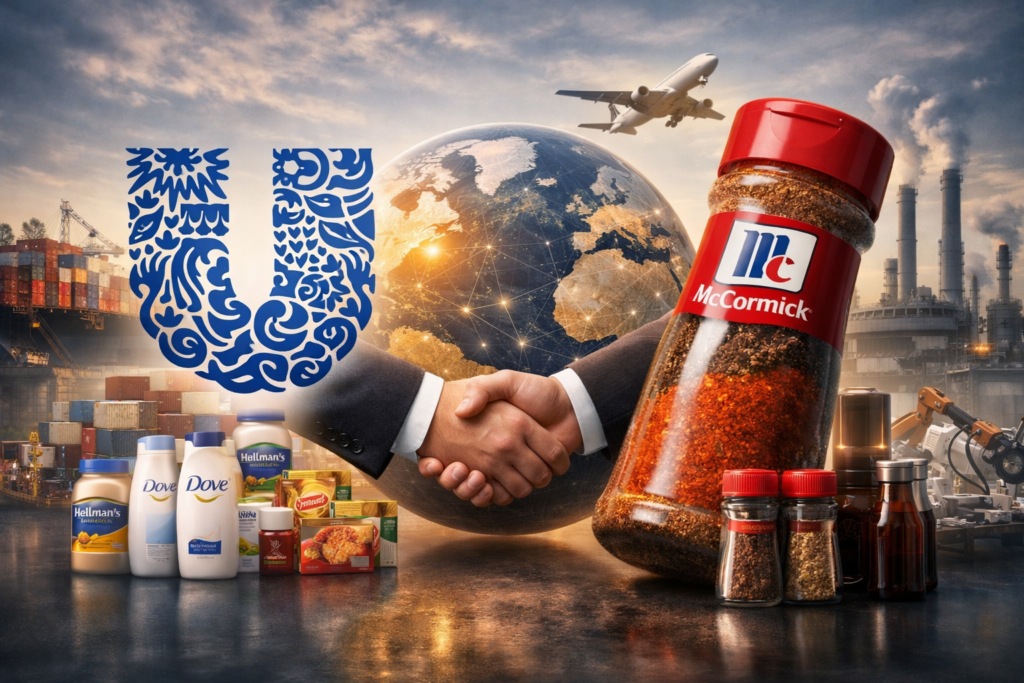
The global consumer goods industry is facing one of its biggest shakeups in years after Unilever agreed to combine most of its food business with McCormick & Company in a deal valued at $44.8 billion. The merger will create a new food and flavor giant with roughly $20 billion in annual revenue and some of the world’s most recognizable brands under one umbrella, including Hellmann’s, Knorr, Marmite, French’s, Frank’s RedHot, Cholula, Old Bay, and Maille.
The deal is structured as a Reverse Morris Trust transaction, allowing Unilever to separate its foods division in a tax-efficient way. McCormick will pay Unilever $15.7 billion in cash and around $29.1 billion in shares. Once completed, Unilever and its shareholders are expected to control around 65% of the combined business, while McCormick shareholders will own the remaining 35%. The transaction is expected to close by mid-2027, pending shareholder approval and regulatory reviews in the United States, Europe, and other major markets.
Why Unilever Is Leaving Food Behind
Unilever has been moving away from slower-growth packaged food categories and focusing more heavily on beauty, personal care, wellness, and home products. Food brands like Knorr and Hellmann’s remain profitable, but they no longer offer the same growth potential as skincare, haircare, and wellness products.
This strategy has been building for more than a year. In 2025, Unilever spun off its ice cream business, including brands like Magnum and Ben & Jerry’s. Now, by separating most of its foods business, Unilever is effectively repositioning itself as a pure-play consumer health and personal care company. The company has already said it plans to use part of the deal proceeds for debt reduction and up to €6 billion in share buybacks between 2026 and 2029.
McCormick’s Biggest Expansion Yet
McCormick has traditionally been known for spices, seasonings, and sauces, but this deal gives the company a much larger global presence in packaged foods, condiments, soups, and cooking aids. It also becomes one of the most important expansion moves in the company’s history.
McCormick expects the combined business to deliver around $600 million in annual cost savings by the third year after the merger. The company also plans to reinvest around $100 million of those savings into product innovation, supply chain improvements, and stronger brand marketing. McCormick sees major growth opportunities in emerging markets, restaurant supply chains, and rising consumer demand for stronger flavors, premium condiments, and spicy foods.
Why India Was Kept Out of the Deal
One of the most interesting details is that Unilever has decided not to include its food businesses in India, Nepal, and Portugal in the transaction. India, in particular, remains one of Unilever’s most important markets through Hindustan Unilever.
India has become one of Unilever’s most valuable food markets. Hindustan Unilever generated ₹15,294 crore in food revenue in FY25, contributing roughly 25% of its total sales with strong profit margins. While food growth is slowing in many Western markets, India continues to deliver faster demand growth, expanding middle-class consumption, and rising spending on packaged food. That is one of the biggest reasons India was kept outside the deal.
Why Investors Are Worried
Despite the size of the deal, investors have reacted cautiously. Unilever shares fell around 7% after the announcement, while McCormick shares dropped between 5% and 7%. Analysts are worried about the complexity of the transaction, the long integration timeline, and the possibility of antitrust scrutiny in categories like sauces, bouillon, condiments, and salad dressings.
There are also concerns that McCormick may be taking on too much debt to finance the deal. The company is trying to absorb a business that is nearly twice the size of its own current operations, which creates major execution risk. Investors will now be watching closely to see whether McCormick can successfully combine two huge global businesses without damaging growth or profitability.